Is It Time for Community Generated Magazines and EZines? #VDM30in30

One thing that the VMware Community has done well is putting together community-organized webinars by presenters who are passionate about the subjects that they are presenting on.  The topics of these weekly webinars range from basic automation to preparation for the advanced VMware Certification exams and Dev-Ops.

As far as I know, this is unique in the world of IT.  I’m not aware of any other community that has organized itself around an ecosystem and provides a plethora of education opportunities that would otherwise cost tens thousands of dollars if it were offered as professional training.

So what does vBrownbag have to do with a magazine made up of community content?

A few months ago, I listened to a VMware Communities Roundtable podcast that featured Stephen Foskett (Twitter: @SFoskett) and Howard Marks (Twitter: @DeepStorageNet).  The main focus of the podcast was about Technical Influencer/Writer/Analyst careers.  One of the things that Stephen discussed in some detail was how the medium-form written article of  about 5000-15000 words has all but disappeared as the technical magazines have folded or reduced their rates to freelance writers as advertising sales fell.  Today, there are very few technical magazines that I am aware of where the articles aren’t advertising for the IT vendors.

This change isn’t necessarily for the better.  It hurts IT as a profession, especially those who are just entering into IT who need resources to help them develop professionally. 

But while the Internet may be the cause of this problem, it also provides a solution.  It’s easy for anyone to create a digital publication.

But wait…isn’t that what blogging is?

To an extent, yes.  But while there are a ton of blogs out there that provide great content, it can be a challenge to find them if you don’t know what you’re looking for.

A solution to this may lie in the PowerShell community.  They have created, through PowerShell.org, what appears to be a community digital magazine with articles written by experts such as Don Jones and Steven Murawski.

Another great example of this is The Virtualization Practice – a news and analysis site staffed by virtualization community experts like Bob Plankers and Edward Haletky. 

Is it time for more sites like these?  I think it is. The decline of more technical related periodicals has left a gap – one that the community is uniquely suited to fill.

American Casserole #VDM30in30

It’s Sunday…and that means another recipe.

This week’s recipe is one that my grandmother used to make all the time.  It’s a very simple and delicious casserole that she called American Casserole.  Like last week’s Baked Mostacciolli, this recipe scales very well (2 pounds of ground meat to each pound of noodles), and it freezes very well.

In some ways, this recipe is like the Cheeseburger Macaroni Hamburger Helper that is layered instead of mixed together.

Ingredients:

  • 2 lbs. of ground meat (turkey, beef)
  • 1 lb. box of elbow macaroni
  • 1 Family Size can of tomato soup
  • 2 cups Milk
  • 3 Eggs, beaten
  • American cheese slices

Directions:

  1. Heat oven to 350 degrees
  2. Brown ground meat and drain fat.  Season to taste.
  3. Combine tomato soup and ground meat.  Set aside.
  4. Cook elbow macaroni to al dente per package directions.  Drain but do not rinse.
  5. Combine milk and eggs.  Add to macaroni and mix well.
  6. Place macaroni mixture in the bottom of a baking pan.
  7. Place meat and tomato soup mixture on top of the macaroni mixture. 
  8. Place American cheese slices on top of the meat layer.
  9. Bake in oven for 30 minutes.

Notes:

  • Do not use whole-wheat pasta with this recipe.  I’ve tried it, but the macaroni layer doesn’t quite bind together.
  • If you’re not a fan of American Cheese slices, you can use other cheese.  Shredded mild cheddar works well too.

Career Thoughts Pt. 1–You Can’t Let Go of Everything to Keep Up with Tech #vdm30in30

Back in September 2013, the IEEE Spectrum published an article with a very interesting statistic: technical professionals need at least 10 hours of training each week just to keep current with the changing technology.  Although this was geared more towards programmers and electrical engineers, it can just as easily be applied to systems administrators and other IT fields.

Ten hours a week doesn’t sound like a lot at first.  That’s only two hours per weekday.  Early in a career it may be easy to set aside two hours per night or a large block of time on weekends, but as your life changes, other priorities start to require that time.

There are very few ways to get that time back, and it usually comes at the expense of sleep or other hobbies and interests.  I’ve heard more than one IT person say that they’ve given up on all non-work related hobbies because they don’t have time to meet their family commitments and keep up with technology.

I’m guilty of this myself.  I’ve set aside hobbies such as photography and reading and writing on non-technical subjects because there isn’t enough time for it.  I’ve traded sleep for lab time.

Doing this is a mistake.  Trading in hobbies and interests for career may benefit your career, but you’re stealing from yourself when you do it. 

Who Are You, and What Have You Done to Microsoft? #VDM30in30

One of the cornerstones of Microsoft’s business has been Office.  Office, along with Windows, has been so successful that its profits have been able to fund a number of less-than-profitable business units over the years and allowed Microsoft to not only survive debacles like the XBox Red Ring of Death but still make a profit while writing off billions in expenses.

Although Microsoft has been pushing Office to a subscription-based service with very affordable non-commercial tiers, I was shocked to see this article from The Verge when I opened up Twitter this morning.

Starting today, you won’t need to have an Office 365 account in order to edit or save documents on IOS or Android devices.  Windows and Mac users don’t get a free version, and they will still need to pony up for an Office 365 subscription to use Office on their PCs.

Although Microsoft has given away products in the past such as the Visual Studio Express Editions and SQL Server Express, I can’t recall a time when they’ve given away one of their core products in a form that wasn’t tied to another revenue generating platform.

OK…that sentence was a little awkward.  What I mean is that while Visual Studio Express and SQL Express are feature limited versions of Microsoft products, they’re still tied to the Windows ecosystem. 

The difference here is that Microsoft is giving away a version of Office, albeit a feature limited one, on platforms that they don’t derive any direct revenue from.

This isn’t an entirely altruistic move – it’s one to ensure that Office remains the dominant productivity platform in the face of multiple mobile options.  It doesn’t really undercut any of their competitors like building Internet Explorer into Windows did to Netscape – Google and Apple already offer free mobile productivity suites as well, and users will have their choice of which suite they want to install and use.

So is this big?  Yes.  Is it shocking?  In some ways, yes.  But its also a move that Microsoft had to make in order to keep Office relevant in an era of open document standards and free alternatives on mobile devices.

Home Lab Expansions #VDM30in30

Over the last two weeks, I’ve made some significant changes to my home lab.  The changes were brought about by a steadily increasing electric bill that had been increasing significantly over the last few months.

I picked up two new servers, a PowerEdge R710 and a PowerEdge R610,  on eBay that will replace the 3-node, 2U Dell DCS6005 that I had been using for my lab.  Both servers come with dual quad-core Xeon processor and 24 GB of RAM.   The R610 will be for server workloads, and the R710 will be for testing out VDI related software.

Although I end up with fewer cores and less RAM for running virtual machines, the two new servers have a few features which make them attractive for home lab use.  The include onboard power monitoring to track electricity usage, and I easily view this within the iDRAC.  The baseboard management on the DCS6005 nodes never worked right, so the new servers had iDRAC6 Enterprise modules added for improved remote management.  The new servers are far quieter than the DCS6005, and I can barely hear them once they are running. They also have more expansion slot, which will allow me to start testing GPUs with Horizon

Election Day is Here #VDM30in30

Today is Tuesday, November 4th.  If you’re in the United States and haven’t been avoiding television (which I wouldn’t blame you if you were), you know that today is the last day of the barely truthful ads attacking candidates using half-truths and lies…I mean it’s Election Day.  It’s the day that we vote for the people who will lead our government for the next two to four years.

I’m not going to get into who I’m voting for.  That’s not important.  The important thing is to find your polling place and cast your vote. 

And then you can be thankful that the campaign ads stop tonight.

Horizon View 6 Part 10–Building Your Desktop Golden Images #VDM30in30

A virtual desktop environment is nothing without virtual desktops.  Poorly performing virtual desktops, or virtual desktops and pools that aren’t configured properly for the applications that are being deployed, can turn users off to virtual desktops and sink the project.

How you configure your desktop base image can depend on the type of desktop pools that you plan to deploy.  The type of desktop pools that you deploy can depend on the applications and how you intend to deploy them.  This part will cover how to configure a desktop base image for linked clone pools, and the next part in this series will cover how to set up a linked clone pool.

Before You Begin, Understand Your Applications

Before we begin talking about how to configure the desktop base image and setting up the desktop pools, its very important to understand the applications that you will be deploying to your virtual desktops.  The types of applications and how they can be deployed will determine the types of desktop pools that can be used.

A few factors to keep in mind are:

  • Licensing – How are the applications licensed?  Are the licenses locked to the computer in some way, such as by computer name or MAC address?  Is a hardware key required? 
  • Hardware – Does the application require specific hardware in order to function, or does it have high resource requirements?  This is usually a consideration for high-end CAD or engineering applications that require a 3D card, but it could also apply to applications that need older hardware or access to a serial port.
  • User Profile and User Installed Applications – Are user profiles being centrally managed, or are they remaining local to the virtual desktops? Are users able to install their own applications?
  • Application Remoting – Can the applications be installed on a terminal server and presented to the users using an application remoting technology such as XenApp or Horizon Application Remoting?

Once you understand the applications that are being deployed to the virtual desktops, you can start planning your pools and creating your base images.

Supported Operating Systems

Horizon View only supports virtual desktops running Microsoft Windows.  The versions of Windows that are supported are:

  • Windows 8.1 Enterprise or Professional
  • Windows 8 Enterprise or Professional
  • Windows 7 Enterprise or Professional
  • Windows Vista Business or Enterprise SP2 (32-bit only)
  • Windows XP Professional SP3 (32-bit only)

Windows Server 2008 R2 is supported as a desktop operating system.  Configuring support for Server 2008 R2 desktops is easier in Horizon 6.0, and it only requires checking a single checkbox instead of editing the Horizon LDAP database.

Terminal Server sessions running on Windows Server 2008 R2 or newer are also supported, but I will cover those in another series.

For this part, we’re going to assume that we’re building a desktop running Windows 7 or Windows 8.1.  This will be more of a high-level overview of creating a desktop template for Horizon View, and I won’t be doing a step-by-step walkthrough of any of the steps for this section.

Configure the VM

Building a desktop VM isn’t much different than building a server VM.  The basic process is create the VM, configure the hardware, install the operating system, and then install your applications.  Although there are a few additional steps, building a desktop VM doesn’t deviate from this.

You should base the number of vCPUs and the amount of RAM assigned to your virtual desktops on the requirements for of the applications that you plan to run and fine tune based on user performance and resource utilization.

The recommended hardware for a virtual desktop is:

  • SCSI Controller – LSI SAS
  • Hard Disk – At least 40GB Thin Provisioned
  • NIC – VMXNET3
  • Remove Floppy Drive, and disable parallel and serial ports in BIOS
  • Remove the CD-ROM drive if you do not have an alternative method for installing Windows.

Note: You cannot remove the CD-ROM drive until after Windows has been installed if you are installing from an ISO.

BIOS Settings
BIOS screen for disabling Serial and Parallel ports and floppy controller

You’ll notice that I didn’t put minimums for vCPUs and RAM.  Sizing these really depends on the requirements of your user’s applications.  I’ve had Windows 7 64-bit desktops deployed with as little as 1GB of RAM for general office workers up to 4GB of RAM for users running the Adobe Suite.

Install Windows

After you have created a VM and configured the VM’s settings, you need to install Windows.  Again, it’s not much different than installing Windows Server into a VM or installing a fresh copy of Windows onto physical hardware.  You can install Windows using the ISO of the disk or by using the Microsoft Deployment Toolkit and PXE boot to push down an image that you’ve already created.

When installing Windows for your desktop template, you’ll want to make sure that the default 100 MB system partition is not created.  This partition is used by Windows to store the files used for BItlocker.

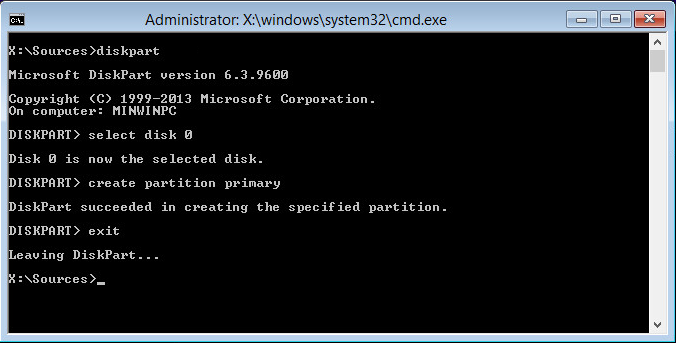
Since Bitlocker is not supported on virtual machines by either Microsoft or VMware, there is no reason to create this partition.  This will require bypassing the installer and manually partitioning the boot drive.  The steps for doing this when installing from the DVD/ISO are:

1. Boot the computer to the installer
2. Press Shift-F10 to bring up the command prompt
3. Type DiskPart
4. Type Select Disk 0
5. Type Create Partition Primary
6. Type Exit twice.
diskpart

Once you’ve set up the partition, you can install Windows normally.  If you’re using something like the Microsoft Deployment Toolkit, you will need to configure your answer file to set up the proper hard drive partition configuration.

Install VMware Tools and Join the Template to a Domain

After you have installed Windows, you will need to install the VMware tools package.  The tools package is required to install the View Agent.  VMware Tools also includes the VMXNET3 driver, and your template will not have network access until this is installed.   The typical installation is generally all that you will need unless you’re using vShield Endpoint as part of your antivirus solution.

After you have installed VMware Tools and rebooted the template, you should join it to your Active Directory domain.  The template doesn’t need to be joined to a domain, but it makes it easier to manage and install software from network shares.

Install View Agent

After you have installed the VMware tools package and joined your computer to the domain, you will need to install the VMware View Agent.  The default install of the View Agent includes all of the features except for PCoIP Smartcard support.  The agent install will require a reboot after it is completed.

Installing Applications on the Template

After you install the View Agent, you can begin to install the applications that your users will need when they log into Horizon View.

With tools like Thinapp available to virtualize Windows applications or layering software like Unidesk or Cloud Volumes, it is not be necessary to create templates for all of the different application combinations.  You can create a base template with your common applications, such as your office suite, pdf reader, etc, and then either virtualize or layer your other applications on top of that.

“Finalizing” the Image

Once you have the applications installed, it is time to finalize the image to prepare it for Horizon View.  This step involves disabling unneeded services and making configuration settings changes to ensure a good user experience.

There are two ways to do this.  The first is to use the batch file provided by VMware in the Horizon View Optimization Guide for Windows 7 and Windows 8.  The other option is to use the VMware OS Optimization fling.

Before you shut the virtual machine down to snapshot it, verify that any services required for applications are enabled.  This includes the Windows Firewall service which is required for the View Agent to function properly.

Shutdown and Snapshot

After you have your applications installed, you need to shut down your desktop template and take a snapshot of it.  If you are using linked-clones, the linked-clone replica will be based on the snapshot you select.

That’s a quick rundown of setting up a desktop template to be used with Horizon View desktops. 

In the next part of this series, I’ll cover how to create a linked-clone pool.

Simple Baked Mostaccioli–#vDM30in30

Sunday isn’t always the best day for writing a tech blog.  So instead of trying to shoehorn a technical topic in on the weekend, I thought I would do Recipe Sundays where I share a recipe from my family cookbook.

The first recipe I’m going to share is one that I’ve been making for over 10 years.  It is one of the first things that I learned to cook when I was in college – baked mostaccioli.

This recipe is very simple to put together, stores well, and can easily be scaled up to feed a small army. 

Ingredients:

1 pound of lean ground beef or ground turkey
1 pound box of Mostaccioli or Penne
1 45 oz.  jar of Ragu Old World Style Traditional Spaghetti Sauce or generic equivalent
16oz shredded Mozzeralla Cheeze
Seasonings
1 9×13 baking pan
Onion Powder
Garlic Powder

Directions:

1. Preheat oven to 350 degrees.
2. Cook pasta per package instructions for 8-9 minutes so that it is slightly undercooked.  Drain, but DO NOT rinse pasta.
3. Season ground meat with onion and garlic powder and brown over medium heat until cooked thoroughly, drain
4. Spread about 1/2 cup of sauce on the bottom of the pan
5. In a large mixing bowl or pot, combine the meat, pasta, remaining sauce and a half cup of shredded cheese.  Mix until pasta and meat are coated with sauce.
6. Pour the pasta and meat mixture into the baking pan and top with remaining cheese.
7. Bake for approximately 35 minutes until cheese is slightly browned and a thermometer reads 165 degrees when inserted into the center.
Note: Cooking times may vary depending on oven and if it was frozen before going into the oven.
8. Allow to stand and cool for 5-10 minutes.